PeerCover
  • Leaky Homes
  • Contact

Cyclones in New Zealand

22/6/2015

0 Comments

 
New Zealand manged to miss a lot of the damage caused by Tropical Cyclone Pam earlier this year. So what is the cyclone risk in New Zealand and how does it compare to say Australia?

The Global Risk Map provides useful insight. The map comes from the PSI Global Resilience Project, which is led by Insurance Australia Group (IAG) and was formally launched at a global insurance industry event in New York in June 2015.

ps If you are wondering why the there is a band around Malaysia where there are no cyclones. The explanation is that this is the 'doll-drums' a place with not much wind. Interestingly this is where cyclones are born but they need lateral wind to get fired up.
0 Comments

Does PeerCover qualify as Microtakaful?

19/6/2015

0 Comments

 
Takaful is the Islamic alternative to conventional insurance. Takaful is based on the idea of social solidarity, cooperation and joint indemnification of losses of the members. It is an agreement among a group of persons who agree to jointly indemnify the loss or damage that may inflict upon any of them out of the fund they donate collectively.

The main purpose of takaful is to help folks through bad times. Profit earnings is not the main goal, while sharing any incidental profits generated is acceptable. Conventional insurance faces barriers under Shariah Law because of: 
  • Maysir (gambling) – underwriting of risks by shareholders in anticipation of a profit is prohibited, 
  • Gharar (uncertainty) – the insured pays premiums in exchange for indemnity against risks that may not occur and 
  • Riba (usury) – the company engages in investments that derive their income from interest and/or prohibited industries.

PeerCover which offers peer-to-peer insurance is a form of co-operative insurance but is it Takeful? Please let us know by commenting to this blog.

For more information on Takeful see: 
  • Hussain, M.M. and Pasha, A. T. (2011). Conceptual and operational differences between general takaful and conventional insurance. Australian Journal of Business and Management Research Vol.1 No.8 [23-28] 
  • World Bank presentation ‘Takaful and Mutual insurers: alternative approaches to managing risk’; 
  • International Co-Operative Alliance web site.
0 Comments

Eliminate deductibles and reduce insurance premiums

17/6/2015

2 Comments

 
insure a peer explains p2p auto insurance. If you would like to learn more about insure a peer, click on their name or send them an email. 
2 Comments

Insurer offering a 35% saving on your insurance – the question you should ask first is how.

12/6/2015

0 Comments

 
Selling insurance is not the same as selling physical goods like oranges or iphones. Insurer’s don’t “run out” of insurance. Subject to capital requirements, insurers can always make more insurance.
However, just like insurer’s can make more insurance they can also make less. How do they do this? They change their terms and conditions. By changing their terms and conditions insurers can add cover which sounds good but is not worth much or remove cover which is costly. Sometimes, to be really tricky, insurers will define cover in a certain way, which may mean the common sense definition does not apply.

If the insurer is just covering you for 35% less or worse 40% less, you may wish to reconsider. There are some good reasons why some insurers are cheaper, for instance:
  • Tower’s insurance SmartDriver can rate your risk better
  • Progressive (not in NZ yet) is 100% online, cutting selling and administration costs
  • PeerCover lets you insure smarter by rating on things that an insurer can’t and sidesteps regulation
  • Some health insurers are investing in wearables like SleepWakeApp
  • AIA's wellness program (not in NZ yet) through Vitality 

So, if an insurer offering a 35% saving on your insurance – the question you should ask first is how.

0 Comments

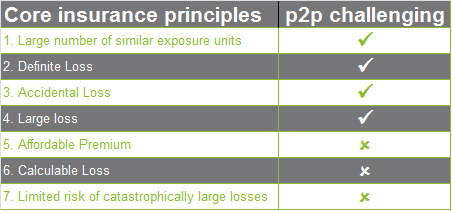
p2p is challenging 4 of the 7 core insurance principles

23/5/2015

0 Comments

 
p2p Insurance is redefining the way we see insurance. Take for example the 7 common characteristics of insurable risks. These 7 principles are often quoted as the core foundations of insurance - p2p is shaking that core:
1. Large number of similar exposure units 
p2p insurance works on a small number of similar exposure units peers. p2p insurance benefits from peer networks reducing agency problems like fraud and exaggeration of claim amounts.

2. Definite Loss 
Most insurance policies are a named peril cover i.e. only defined risks are covered. But this fails to cover unknown risks i.e. what is left over, after you think you've thought of everything. p2p insurance is taking a broader view of risk - in some cases looking to define risk after it has happened.

3. Accidental Loss 
Whilst it makes sense that only fortuitous events should be covered or at least those events outside the control of the beneficiary of the insurance, when you look at the real world it is not so black and white. For instance, is divorce fortuitous - HK p2pInsurer Tong Ju Bao thinks not.

4. Large loss 
Insurers have concentrated on insuring the big ticket items because the frictional cost of insurance (capital, regulation, policy administration etc) making insuring the small stuff uneconomical. The internet and cell phones has changed all of that - many frictional costs are no more. We are seeing a few areas challenging this principle, micro-insurance is just one.

5. Affordable Premium 
If the premium is large relative to the amount of protection offered, then why buy insurance. I think this applies to p2pInsurance as well.

6. Calculable Loss 
This covers off whether a reasonable estimate can be made as to the frequency and severity of losses. It speaks to whether insurance can be equitable i.e. premiums are fair and whether a reasonable claim amount can be determined. The calculation doesn't have to be exact but should be close enough - I think p2pInsurer's simple rules cover this. 

7. Limited risk of catastrophically large losses 
This is in-built into p2p Insurance because no matter what happens the maximum peers can be paid is what is in the pool.

So, p2p is challenging 4 of the 7 core insurance principles. Not bad for a new starter.
Picture
0 Comments

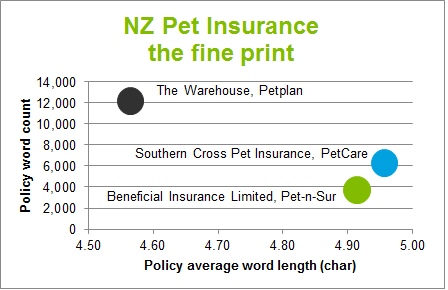
NZ Pet Insurance Small Print

17/5/2015

0 Comments

 
Picture
We looked at the three major pet provider's policies and did the math. Whether more words means more cover or more exclusions - we will leave for you to work out. If you worried about the gaps or can't get pet insurance for your pet and want something more - consider PeerCover.

A shout out to felix the cat for the pdf word counter.
0 Comments

Public Database of Debits and Credits

16/5/2015

0 Comments

 
Like google docs or sheets, this is a public database of debits and credits. Also known as Decentralized Value Transfer Systems (DVTS). The best known example right now is BitCoin, but there are others, such as Etherium and RippleLabs.

Just like google docs or sheets, there are controls around database entries. Entries are verified through a process known as the blockchain. For added security, multiple copies of the database are made on multiple computers - any unauthorized transaction would need to alter all these copies - very difficult to do in practise. Unlike google docs or sheets, there is no owner – the database is decentralized.
Being decentralised, it made sense to use a decentralised or global currency. The public database of debits and credits uses the Bitcoin.

The database is set up to provide an avenue for the transfer of value without the need for the central structure usually provided by a financial institution. peercover.com (the American company  related only by name) was looking to use a public database of debits and credits to provide a market place between insured and insurers. 

PeerCover.co.nz is keeping an eye on the progress of the public database of debits and credits. However, at this stage peercover will not be using this technology until it is further proved-up .

0 Comments

PetCover - to insure, self-insure or now - to PeerCover?

16/5/2015

0 Comments

 
​Due to pet insurance coverage gaps or exclusions, which may include:
  • Pre-existing conditions, 
  • A co-share percentage or excess,
  • Benefit limits (restrictions) 
  • Your animal ‘too old’
  • Your pet ‘too’ fat 

You may have thought the only way to prepare for the uncertain vet bills is opening a special bank account with a regular deposit to build it up. Now there is another way - PeerCover.

With PeerCover you and your fellow pet owners can band together to PeerCover your pet. How much you can claim depends on how much you deposit through PeerCover. Unlike insurance, you and your peers have the final say what is a valid claim - so you are not left with any nasty surprises. 

PeerCover charges a fixed $100 fee per claim to manage the platform and provide the PeerGroup with an independent recommendation on whether the claim should be paid.

For more information on the to insure or self-insure, see the choice article. To join-up to PeerCover click on the button below.
Join-up
0 Comments

#p2pInsurance sits between full insurance and self-insurance

13/5/2015

0 Comments

 
0 Comments

Supplement your third party car insurance

8/5/2015

0 Comments

 
Are you saving on car insurance by buying third party only cover but worried about the cost of repairing your vehicle if you get in a crash?

Third party insurance car insurance only covers the costs of the other persons damages - you have to fund your own car's damage yourself. To cover your own damage you can buy comprehensive cover but often this is expensive and may not cover everything that you want it to.

There is now a new cost effective option - PeerCover. With PeerCover you and your network can cover the cost of damage to your own vehicles. You do not have to change insurance - you can still use your current third party insurer to cover the cost of other people's damages.

PeerCover is flexible - choose the level of cover and who you want in your PeerGroup. You can even choose to have no-one else in your PeerGroup and use PeerCover as a way to save in order to fund the cost of your own damages. With PeerCover you and your PeerGroup make a deposit through PeerCover (to fund future claim costs) but unlike insurance if no-one in your PeerGroup claims you get 100% of your deposit back.

PeerCover only charges a small fee ($100 per claim) to provide the service - so PeerCover may be what you have been looking for to supplement your current third party only car insurance.
0 Comments
<<Previous
Forward>>

    Author

    PeerCover Founder

    Archives

    October 2017
    July 2017
    June 2017
    August 2016
    June 2016
    May 2016
    January 2016
    December 2015
    November 2015
    October 2015
    September 2015
    July 2015
    June 2015
    May 2015
    April 2015
    March 2015
    February 2015
    October 2014

    Categories

    All
    Car Cover
    Funeral Cover
    Health Cover
    Insurance Fails
    Insurance Innovation
    P2p Insurance
    Pet Cover
    Phone Cover
    Sharing Economy

    RSS Feed

PeerCover Limited
  • Leaky Homes
  • Contact